
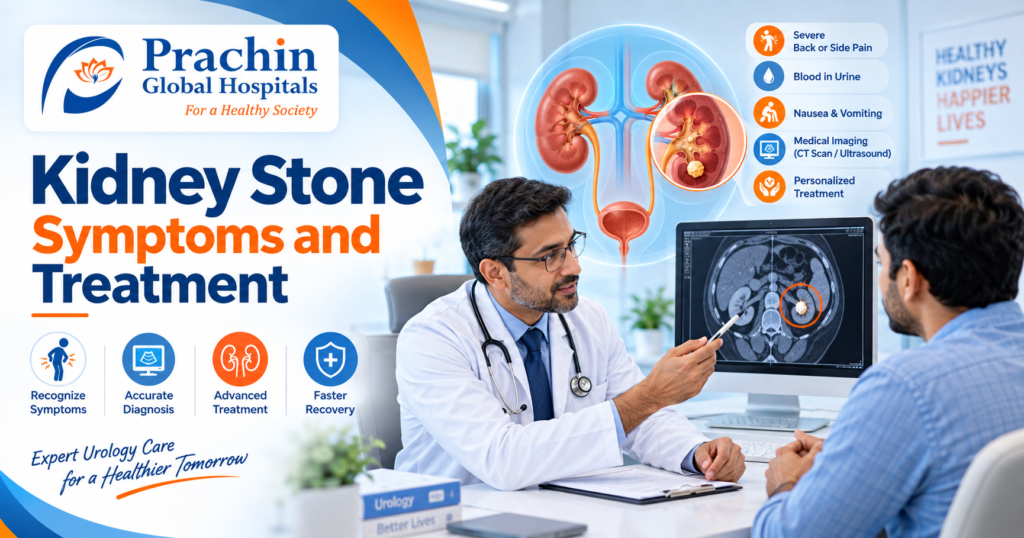






Kidney stones are hard mineral deposits that form inside the kidneys. They affect people of all ages and are becoming more common as diets, work habits, and hydration levels change. A stone may stay silent for months, then trigger sudden, intense pain when it starts to move.
The good news is that stones are treatable, and the earlier they are found, the simpler the treatment usually is. This guide covers the main kidney stone symptoms and treatment options, along with practical steps to prevent a repeat episode.
At Prachin Global Hospital, our team in Patancheru helps patients through every stage: diagnosis, treatment, recovery, and long-term prevention.
Your kidneys filter waste from the blood and pass it out as urine. When urine holds too much calcium, oxalate, or uric acid, and too little fluid, these substances can crystallise and stick together. Over time, the crystals grow into a stone.
Doctors classify stones by their composition. Calcium stones are the most frequent. Uric acid stones are linked to a protein-rich diet. Struvite stones often follow infections, and cystine stones are rare and inherited. Knowing the type helps your doctor choose the right treatment and prevention plan.
Small stones inside the kidney may cause no discomfort. Symptoms usually begin when a stone travels into the ureter, the narrow tube that carries urine to the bladder, and blocks the flow. Spotting kidney stone symptoms early lets you seek help before complications develop.
Visit a hospital right away if you have severe pain with fever, cannot pass urine, are vomiting continuously, or notice heavy blood in your urine. A blocked, infected kidney can be damaged quickly if it is not treated
Back pain has many possible causes, so an accurate diagnosis matters. At Prachin Global Hospital, your doctor will begin by asking about your symptoms, diet, and medical history. Depending on your case, the following tests may be advised:
These results tell your doctor how likely the stone is to pass naturally and whether a procedure is needed. To learn more about the tests available, see our diagnostics and laboratory services.
Effective kidney stone treatment depends on the stone’s size, its location, and your overall health. Some patients only need medication and fluids. Others benefit from advanced, minimally invasive procedures.
Stones up to about 5 mm often pass on their own within a few weeks. During this time, your doctor may recommend:
Please avoid taking painkillers or home remedies without consulting a doctor, as some can harm the kidneys.
Extracorporeal shock wave lithotripsy uses focused sound waves from outside the body to break the stone into small pieces. These fragments then pass out in the urine. There is no incision, and most patients recover quickly.
For stones stuck in the ureter or kidney, a thin scope is guided through the natural urinary passage. A laser fragments the stone, and the pieces are removed. Since no cuts are made, discomfort is limited, and patients typically return to routine activities sooner. Explore our urology and laser stone surgery services for more information.
When a stone is large or hard, percutaneous nephrolithotomy is often the preferred option. A small keyhole opening in the back allows the surgeon to break up and remove the stone directly. It offers thorough clearance with a shorter stay and faster healing than traditional open surgery.
If a stone is blocking the kidney or an infection is present, a soft tube called a stent may be placed to restore drainage and protect the kidney until the stone is treated.
Anyone who has had a stone has a higher chance of developing another, so prevention deserves as much attention as treatment.
Our blog on kidney-friendly diet tips offers meal ideas that support healthy kidneys.
When you are in pain, you want care that is quick, clear, and compassionate. Prachin Global Hospital is a super speciality hospital serving Patancheru and the surrounding areas. Patients rely on us for:
Whether you are facing your first stone or have dealt with recurring episodes, our specialists are here to help you find lasting relief.
Kidney stone pain should never be ignored. If you notice back or side pain, blood in your urine, or any of the symptoms above, seeking help early can prevent complications and shorten your recovery.
Contact Prachin Global Hospital today to book an appointment with our specialists. Call our team or fill out the enquiry form on our website, and we will guide you to the right care.
Back pain, blood in urine, and burning urination are early signs. Find Kidney Stone Symptoms and Treatment in Patancheru with experts.
See a doctor for severe pain, fever or vomiting. Get timely Kidney Stone Symptoms and Treatment in Patancheru at Prachin Global Hospital.
Urine tests, ultrasound, and CT scans confirm stones. Choose Kidney Stone Symptoms and Treatment in Patancheru with accurate diagnosis.
Small stones often pass with fluids and medicines. Kidney Stone Symptoms and Treatment in Patancheru include surgery for larger ones.
Drink plenty of water and cut salt. Prachin Global Hospital offers Kidney Stone Symptoms and Treatment in Patancheru with prevention advice.
WhatsApp us