








Kidney stones are one of the most common urological problems affecting people across all age groups today. The sudden, sharp pain associated with this condition can disrupt daily life within moments, making early recognition and timely treatment essential. At Prachin Global Hospital, our team of experienced urologists specializes in diagnosing and treating kidney stones using advanced, minimally invasive techniques that ensure faster recovery and long-term relief.
This guide walks you through everything you need to know about Kidney Stone Symptoms and Treatment, including causes, warning signs, diagnostic methods, and the most effective treatment options available today.
Kidney stones are hard, crystalline deposits formed from minerals and salts that accumulate inside the kidneys. They can vary in size, from as small as a grain of sand to as large as a golf ball, and may remain in the kidney or travel through the urinary tract. When a stone moves into the ureter, it often causes intense pain, commonly known as renal colic.
Several factors contribute to stone formation, including dehydration, poor dietary habits, obesity, family history, and certain underlying medical conditions such as hyperparathyroidism or urinary tract infections. Understanding these risk factors is the first step toward prevention, which our specialists discuss in detail during every consultation at our Urology Department.
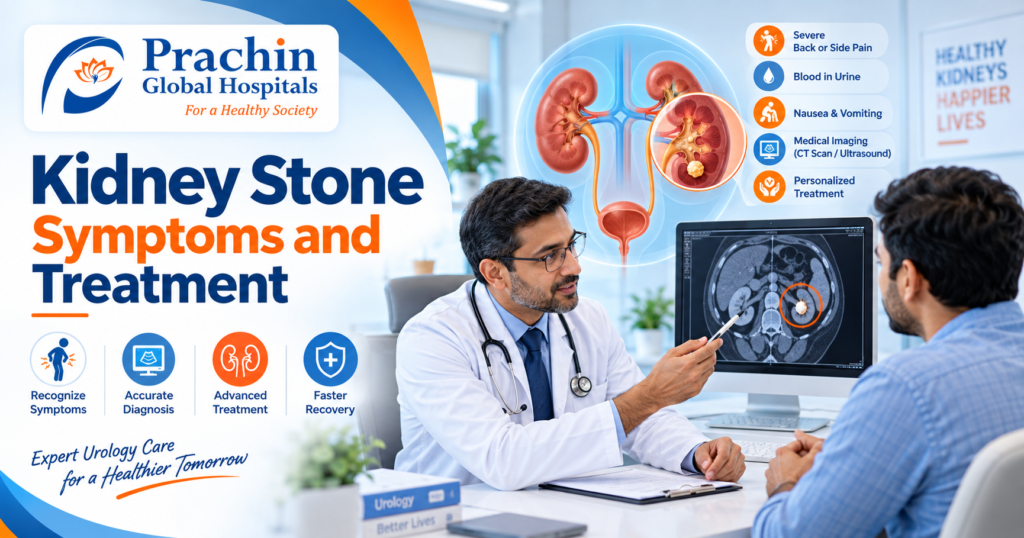
Recognizing Kidney Stone Symptoms early can help prevent complications such as infection, kidney damage, or urinary blockage. While small stones may pass without noticeable symptoms, larger stones typically cause the following signs:
If you experience persistent flank pain along with fever, it is important to seek immediate medical attention, as this could indicate a serious infection requiring urgent care. Our Emergency Care Services at Prachin Global Hospital are available around the clock for such situations.
Accurate diagnosis is essential for choosing the right treatment approach. At Prachin Global Hospital, our diagnostic process typically includes:
These diagnostic tools allow our urologists to design a personalized treatment plan based on the stone’s size, composition, and location, along with the patient’s overall health condition.
Treatment for kidney stones depends largely on the size and position of the stone, as well as the severity of symptoms. Prachin Global Hospital offers a comprehensive range of Kidney Stone Treatment options, from conservative management to advanced surgical procedures.
For smaller stones, typically under 4-5 millimeters, doctors often recommend:
When stones are too large to pass naturally, our specialists use advanced techniques that minimize discomfort and recovery time:
Extracorporeal Shock Wave Lithotripsy (ESWL): This non-invasive procedure uses focused shock waves to break stones into smaller fragments, which then pass through the urine naturally. It is one of the most commonly used treatments for moderately sized stones.
Ureteroscopy (URS): A thin scope is passed through the urethra and bladder to reach the stone, which is then removed or broken down using a laser. This procedure is particularly effective for stones lodged in the ureter.
Percutaneous Nephrolithotomy (PCNL): Recommended for larger or complex stones, this minimally invasive surgical procedure involves a small incision in the back to directly access and remove the stone from the kidney.
Our Advanced Laser Stone Treatment programs at Prachin Global Hospital combine the latest technology with experienced surgical expertise to ensure precise, safe, and effective stone removal with minimal downtime.
In rare and complicated cases, open surgery may be required, particularly when stones are extremely large or when other treatment methods have not been successful. Our surgical team ensures that this option is considered only after evaluating all safer alternatives.
Once treated, preventing recurrence becomes a priority. Our doctors at Prachin Global Hospital recommend the following lifestyle changes:
Personalized dietary and lifestyle counselling is available for every patient as part of our continued care program, helping reduce the chances of future stone formation significantly.
At Prachin Global Hospital, we combine clinical expertise with state-of-the-art technology to deliver comprehensive urological care. Our multidisciplinary team focuses on accurate diagnosis, minimally invasive treatment options, and personalized patient care at every step of the journey.
Key reasons patients trust us include:
Whether you are experiencing early symptoms or have already been diagnosed with kidney stones, our specialists are equipped to guide you through every stage of treatment with compassion and clinical precision.
Do not let kidney stone pain disrupt your daily life. Early diagnosis and the right treatment can make all the difference in your recovery and long-term kidney health. At Prachin Global Hospital, our dedicated team of urology specialists is here to provide accurate diagnosis, effective treatment, and compassionate care tailored to your needs.
Contact Us Prachin Global Hospital, today to schedule a consultation with our expert urologists and take the first step toward lasting relief from kidney stones.
Kidney Stone Symptoms and Treatment often begin when minerals crystallize in concentrated urine.
Kidney Stone Symptoms and Treatment guides list sharp back pain, blood in urine, and frequent urination.
Mild Kidney Stone Symptoms and Treatment cases often resolve with fluids and pain relief alone.
Kidney Stone Symptoms and Treatment need urgent care if fever, chills, or vomiting occur.
Kidney Stone Symptoms and Treatment rely on ultrasound, CT scans, and urine tests
WhatsApp us